‘From Berlin to Belgrade and Barcelona: The story of Wolves in Europe’ by club historian, Pete Crump
As a founder member of English league football, Wolves are also pioneers of the European game, with the club having played a vital part in the formation of competitive continental football.
In the early 1950s, Wolves were among the first British clubs to embrace floodlit football, inviting leading sides from across the world to Molineux to face off against Stan Cullis’ iconic team.
Those games ensured the Wolves name was known across the world, but one particular floodlit night in the Black Country against Hungarian outfit Honved in December 1954 ended up being the catalyst for the creation of the European Champion Clubs’ Cup – now known as the UEFA Champions League.
This is the story of how Wolves have since fared when competing in European club football during the last seven decades.
Originators of European football
The Honved game on 13th December 1954, as we know, was huge. Not just here at Molineux but also in terms of the ramifications it had for European club football.
We have discussed the Honved game at length in recent times. It was covered extensively in December 2024 as part of the Honved 70-year celebrations.
Wolves, and especially the Honved game, played a huge part in the creation of the European Cup, and although it is true that European football competition was spoken about prior to this, that iconic night in December 1954 helped turn the European Cup into a reality.
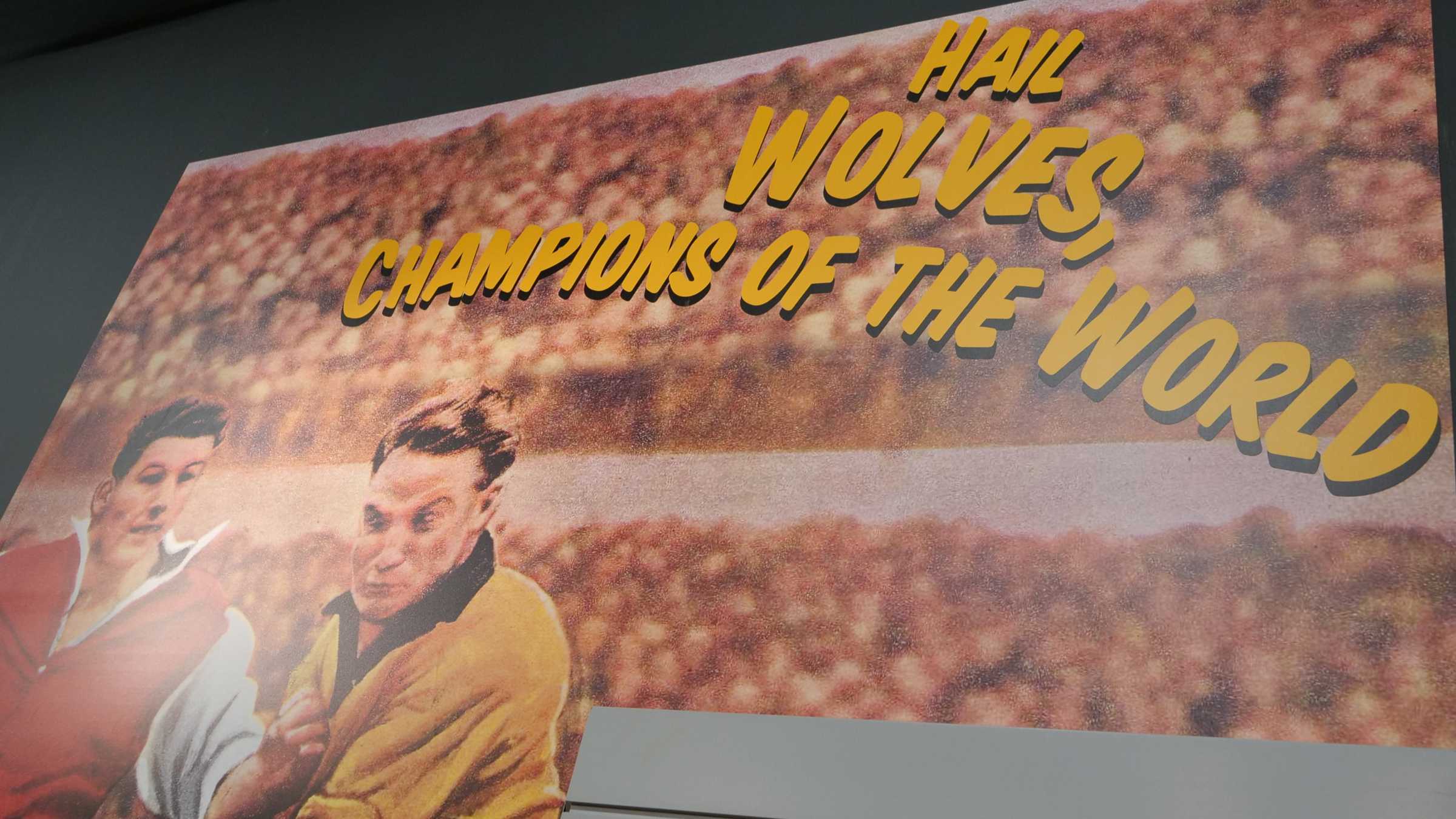
It is often stated that L'Equipe journalists Jacques Ferran and Gabriel Hanot are the founders of the European Cup. The Daily Mail’s front page carried the headline ‘Hail Wolves, Champions of the World’ after the Honved game. Hanot replied by saying:
“Before we declare that Wolverhampton are invincible, let them go to Moscow and Budapest. And there are other internationally renowned clubs: Milan and Real Madrid to name but two. A club world championship, or at least a European one – larger, more meaningful and more prestigious than the Mitropa Cup and more original than a competition for national teams – should be launched”
March 1955 saw the proposal by L'Equipe discussed at the Congress meeting, and it was approved in April with a start date of the following season. The first European Cup therefore began in 1955.
It was Chelsea who became the first English team to be invited into the tournament having been named the 1954/55 champions of England, taking our crown after we had won our inaugural First Division title in 1953/54.
Chelsea, however, did not end up playing, as pressure was put on them by the Football League and they were denied the honour of being the first-ever English club to play in the tournament.
The first British club to play in the European Cup was Hibernian. Hibs strangely had only finished in 5th place in what was then known as Scottish League A, now the SPL. Ahead of them were champions Aberdeen, Celtic, Rangers and Hearts. The reason for Hibs’ invitation, we believe, was their floodlights.
Pittodrie, Aberdeen’s stadium, did not get floodlights until October 1959, Celtic also did not have floodlights until earlier the same month. Wolves visited Celtic Park to open their floodlights in a friendly on 12th October 1959. Hearts’ floodlights came in 1957, and while Rangers did have floodlights, despite this, it was Hibs who made the bow, and ended up making it all the way to the semi-final.
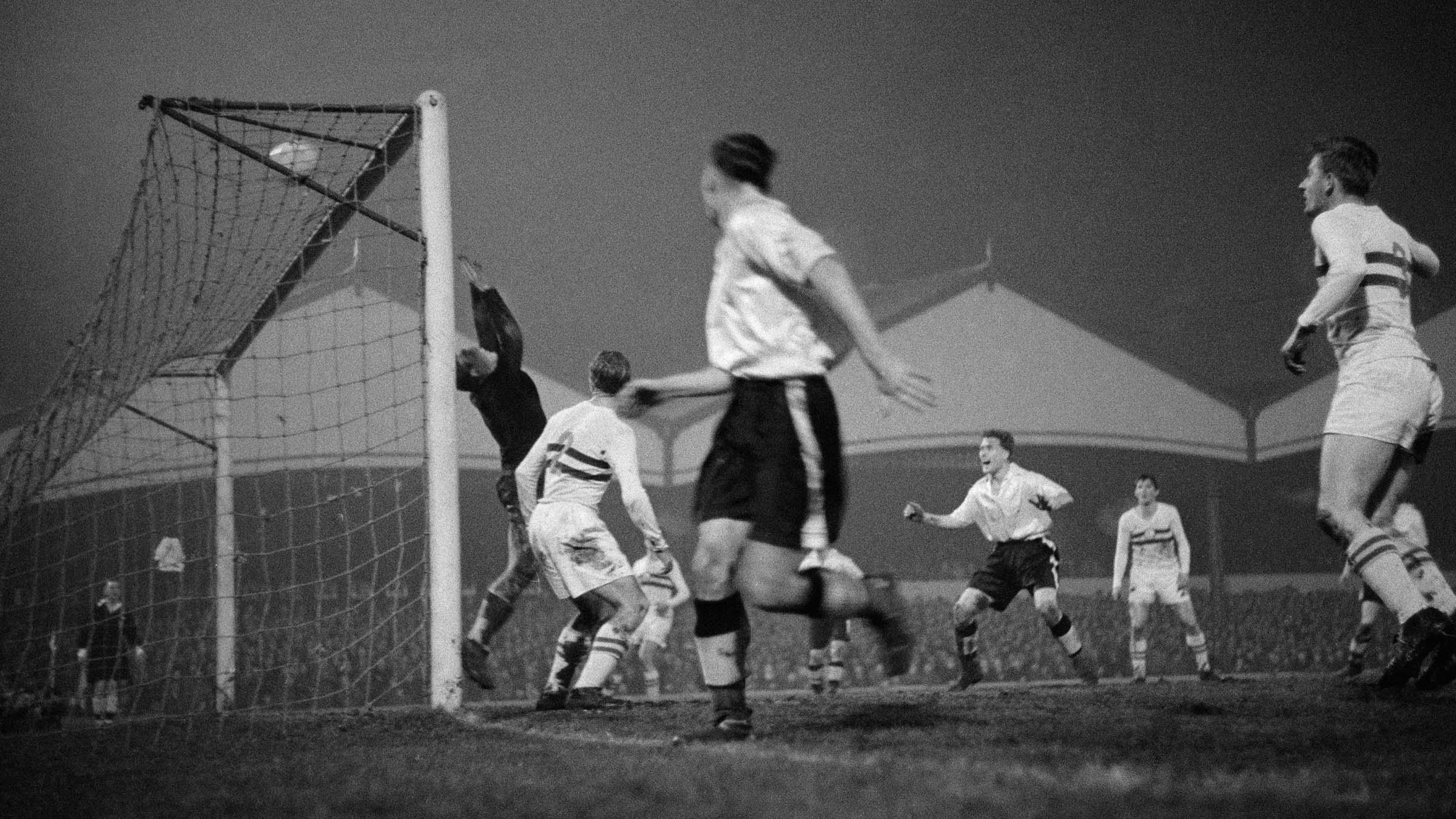
The first English team to play in the European Cup was Manchester United in 1956/57 and then again in 1957/58, making the semi-finals in both years. Their second European Cup adventure, however, saw tragedy with the Munich air disaster on 6th February 1958, as United were on the way back from Belgrade after the second leg of the quarter-final.
They were due to play Wolves on their return at Old Trafford on Saturday 8th February 1958, but this was of course postponed. It would also be Wolves that were the next English team to play in the European Cup.
European Cup 1958/59
Wolves were invited into the European Cup in 1958 having been crowned champions of England for the second time. Manchester United were also invited to take part following the events of the previous season, however, the Football League prevented them from playing. If United had played, we would have been the first nation to have two teams in the competition.
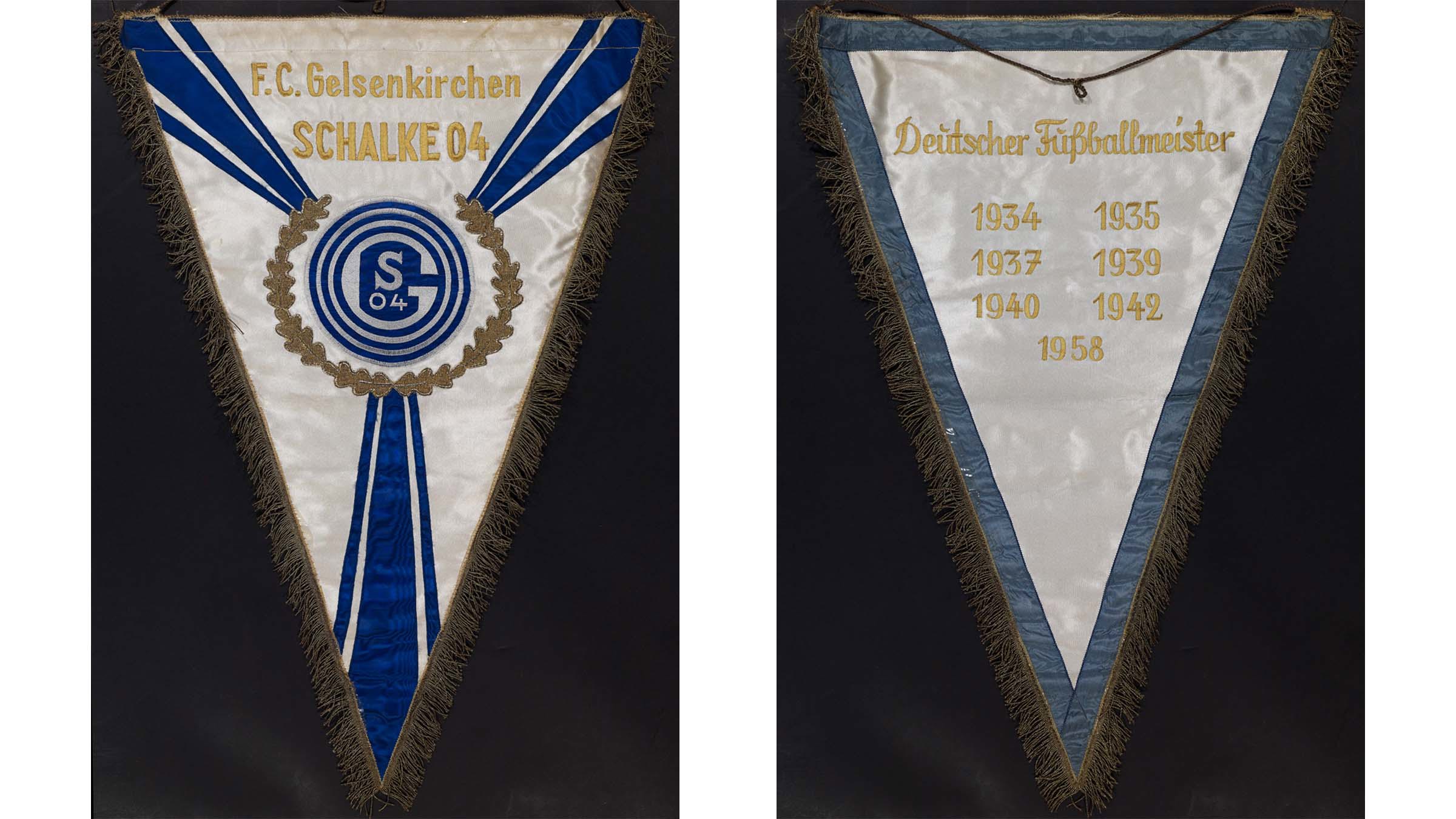
Wolves’ first-ever game in the European Cup, and thus a European club football tournament, was on Wednesday 12th November 1958, when we faced German side Schalke 04. The Germans took the lead in the 23rd minute, but in the second half, the legend Peter Broadbent scored the equaliser and then put Wolves into the lead with a brace. Schalke, however, scored a crucial equaliser in the later stages of the game, which really would prove costly.
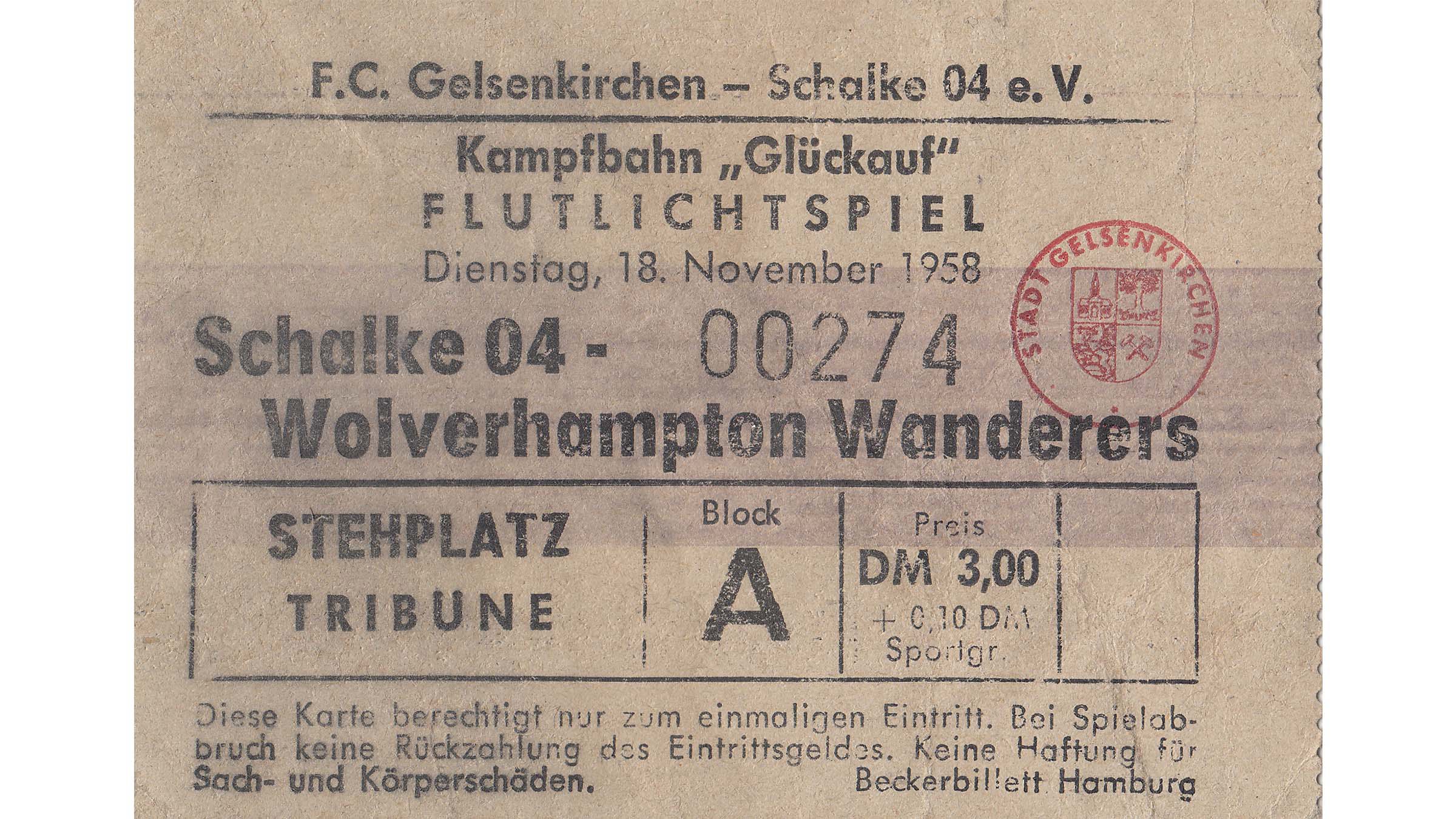
The following week, Wolves lost 2-1 at the Parkstadion. The Wolves goalscorer that day was, interestingly, Alan Jackson, who would only play six times for the first-team – including both legs of this tie – and scored two goals.
Wolves were also missing the influential Bill Slater in Germany due to his work at university, with the Old Gold losing the tie 4-3 on aggregate, meaning their first foray into Europe was over at the first hurdle.
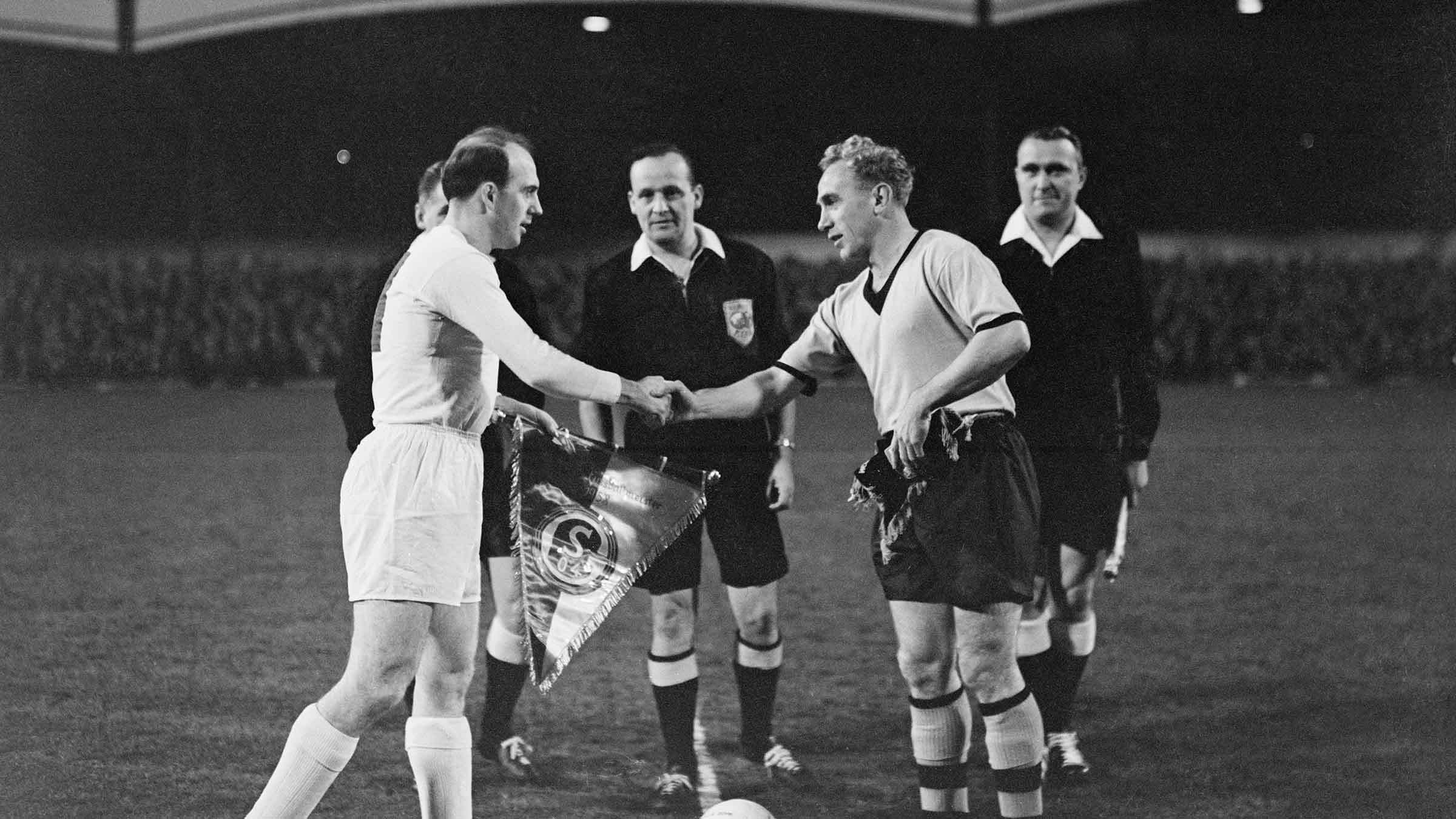
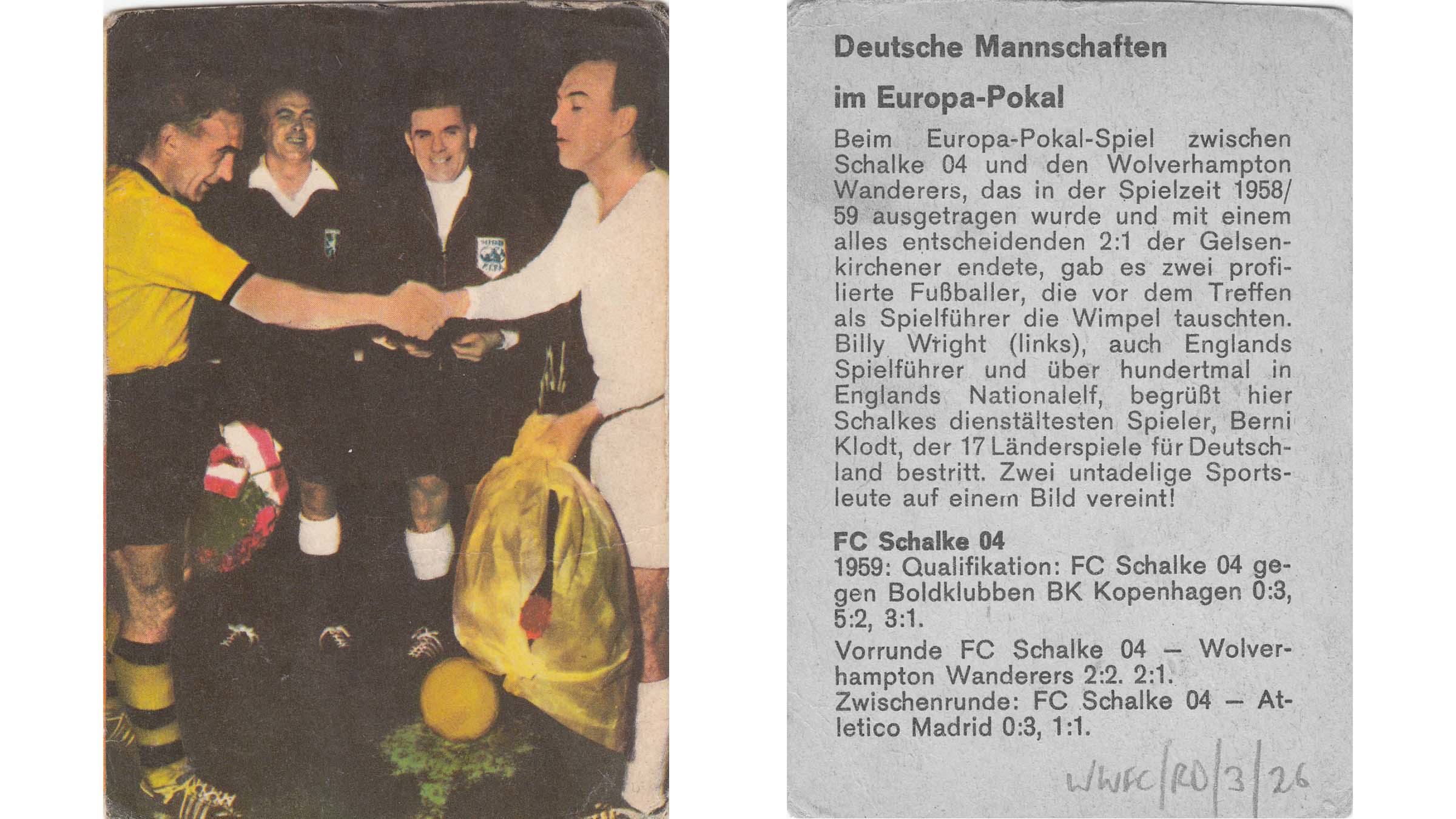
It still goes down in history, and we are proud to display the Schalke pennant that was exchanged during the tie in the Wolves Museum.
European Cup 1958/59 | First round, first leg
Wednesday 12th November 1958
Wolves 2 (Broadbent 48, 65) Schalke 04 2 (Siebert 23, Koslowski 87)
Attendance | 45,767
European Cup 1958/59 | First round, second leg
Tuesday 18th November 1958
Schalke 04 2 (Koerdel 12, Siebert 39) Wolves 1 (Jackson 48)
Attendance | 25,000
Wolves lose 4-3 on aggregate
European Cup 1959/60
Following a first taste of European football, Wolves were back in the European Cup the following year after winning back-to-back league titles. It is also our final top-division title to date.
The tournament would also see Wolves return to Germany, but this time East Germany and behind the Iron Curtain.
The 1959/60 competition also saw Wolves start in the preliminary rounds and the opening game this year was against East German runners-up ASK Vorwarts.
Vorwarts were an army sports club that did not just play football, they also played handball and rugby, and participated in judo. In 1969, they relocated to Frankfurt but unfortunately no longer exist at all in the same guise.
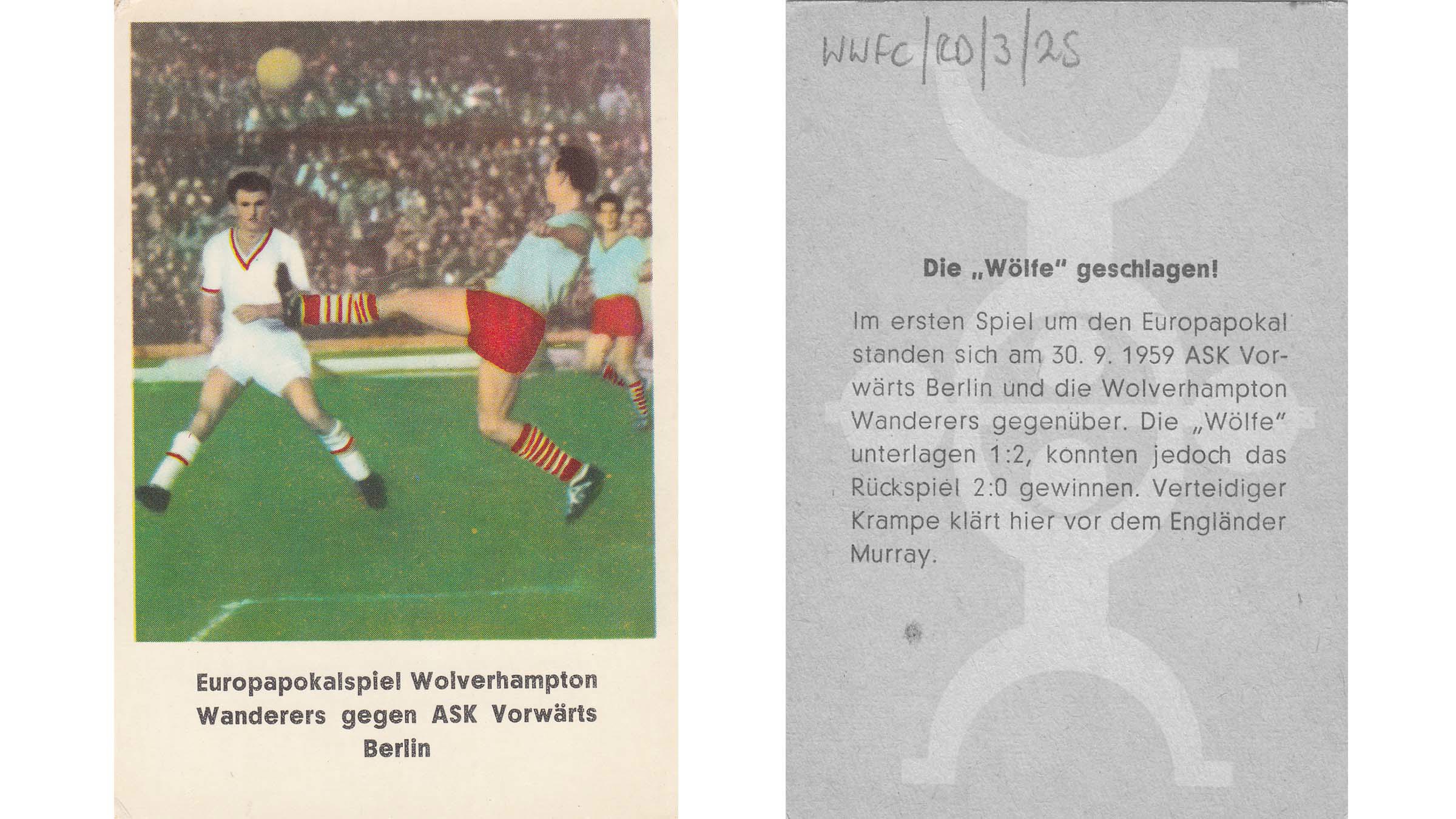
Wolves lost the first leg in East Berlin, however, the amazing Peter Broadbent had put Wolves 1-0 up and grabbed an away goal allowing his side to turn the tie around at Molineux in the second leg with a solid 2-0 win. Broadbent and Bobby Mason causing the damage to knock the East Germans out.
European Cup 1959/60 | Preliminary round, first leg
Wednesday 30th September 1959
ASK Vorwarts 2 (Noldner 24, Kohle 28) Wolves 1 (Broadbent 16)
Attendance | 65,000
European Cup 1959/60 | Preliminary round, second leg
Wednesday 7th October 1959
Wolves 2 (Broadbent 54, Mason 76) ASK Vorwarts 0
Attendance | 55,747
Wolves win 3-2 on aggregate
Next up in the first round was another interesting trip to the Eastern Bloc. It was an extremely tough assignment in Belgrade, then part of Yugoslavia, as Wolves travelled to Partizan Stadium to face Red Star Belgrade.
Wolves also picked up a very handy draw, despite Stan Cullis being furious with the referee’s performance in the game. The exact word he used to describe the referee’s performance was “deplorable”. Norman Deeley put Wolves 1-0 up, but Red Star equalised before the break.
In the return leg at Molineux, Wolves were 1-0 up after only seven minutes, and in the final four minutes of the game, Bobby Mason ensured Wolves’ passage to the next round with a brace.
Red Star Belgrade still play today, however, Belgrade is now the capital of Serbia after the dissolution of Yugoslavia, which began in 1991. This saw horrendous conflict from 1991 to 2001, and there has been more dissolution since 2001 with the creation of independent states such as Slovenia, Croatia, Bosnia and Herzegovina, Montenegro, Serbia, Kosovo and North Macedonia. The last World Cup that Yugoslavia appeared in as a totally unified nation was Italia 90.
European Cup 1959/60 | First round, first leg
Wednesday 11th November 1959
Red Star Belgrade 1 (Kostic 37) Wolves 1 (Deeley 28)
Attendance | 62,000
European Cup 1959/60 | First round, second leg
Tuesday 24th November 1959
Wolves 3 (Murray 7, Mason 86, 90) Red Star Belgrade 0
Attendance | 55,519
Wolves win 4-1 on aggregate
The next round would see Wolves struggle as the side travelled to the Nou Camp to play Barcelona in the quarter-finals on 10th February 1960.
Wolves suffered a 4-0 loss in Spain and if the players were also hoping for any light relief at Molineux, then sadly this would not be the case as they were demolished 5-2.
It was also a familiar foe who caused most of the damage, as Sandor Kocsis scored four goals that evening. Kocsis was one of the ‘Mighty Magyars’ from Hungary who starred against England in the two famous internationals prior to the Wolves-Honved game. Kocsis also scored one of the two goals that had put Honved 2-0 up at half-time in our famous game at Molineux on 13th December 1954.
The loss against Barca at Molineux was our first loss in the so-called floodlight series of 23 games between 30th September 1953 and 13th December 1962. In this series, Wolves played 16 friendlies, four European ties, two Cup Winners’ Cup ties and one Charity Shield game, and this was the only one where we tasted defeat.
European Cup 1959/60 | Second round, first leg
Wednesday 10th February 1960
Attendance | 80,000
Barcelona 4 (Villaverde 8, 81, Kubala 18, Evaristo 65) Wolves 0
European Cup 1959/60 | Second round, second leg
Wednesday 2nd March 1960
Attendance | 55,535
Wolves 2 (Murray 35, Mason 80) Barcelona 5 (Kocsis 29, 42, 60, 76, Villaverde 81)
Wolves lose 9-2 on aggregate
The Barcelona tie is the last time to date Wolves have played in the European Cup. Although our adventures in that competition may have been over in March 1960, our continental adventures were not, with Wolves back in Europe the season after.
European Cup Winners’ Cup 1960/61
The early 1960s saw Wolves have a couple of good league seasons and narrowly missed out on the First Division league title in 1959/60 which would have meant winning three First Division league titles in a row and also winning the double.
Although this also meant missing out on the European Cup, Wolves’ win in the 1960 FA Cup meant they secured their place in the inaugural season of the Cup Winners’ Cup – the only time we participated in that competition.
Nine other teams participated alongside Wolves that year; Austria Vienna (Austria), Ruda Hvezda Brno (Czechoslovakia), ASK Vorwarts (East Germany), Borussia Monchengladbach (West Germany), Ferencvaros (Hungary), Fiorentina (Italy), Rangers (Scotland), FC Lucerne (Switzerland) and Dynamo Zagreb (Yugoslavia).
In October 1960, Wolves played their first match away at Austria Vienna in the quarter-final first leg, however, they lost 2-0 in front of 25,000 at the Prater Stadium.
In the return leg at Molineux in November, Wolves turned up in full force, winning 5-0 with two goals each from Johnny Kirkham and Broadbent, while Mason also got one, which meant Wolves progressed 5-2 on aggregate.
European Cup Winners’ Cup 1960/61 | First round, first leg
Wednesday 12th October 1960
Austria Vienna 2 (Riegler 71, Huscheck 85) Wolves 0
Attendance | 25,000
European Cup Winners’ Cup 1960/61 | First round, second leg
Wednesday 30th November 1960
Wolves 5 (Kirkham 1, 26, Mason 35, Broadbent 70, 72) Austria Vienna 0
Attendance | 31,699
Wolves win 5-2 on aggregate
The win over Vienna set up an all-British affair in the semi-final stage. Our opponents were Glasgow Rangers, who had seen off Ferencvaros 5-4 and Monchengladbach 11-0 to reach this stage.
Wolves travelled to Ibrox on 29th March 1961 but lost 2-0 in front of an estimated crowd of 80,000. This would be the last time to date Wolves have played at the famous old ground.
Cullis’ side were hopeful of a repeat of the form shown against Austria Vienna in the home leg, unfortunately, it wasn’t to be, with a 1-1 draw playing out on the 19th April 1961. Broadbent scored the goal, but it was not enough as Wolves went out 3-1 on aggregate.
European Cup Winners’ Cup 1960/61 | Second round, first leg
Wednesday 29th March 1961
Glasgow Rangers 2 (Scott 34, Brand 84) Wolves 0
Attendance | 80,000
European Cup Winners’ Cup 1960/61 | Second round, second leg
Wednesday 19th April 1961
Wolves 1 (Broadbent 63) Glasgow Rangers 1 (Scott 45)
Attendance | 45,163
Wolves lose 3-1 on aggregate
The home leg at Molineux led to the famous terrace chant “When the Rangers came to Wolverhampton Town”, which is still sung by Rangers supporters to this day. The away support Rangers brought is arguably one of the biggest followings that we have ever seen at Molineux – travelling in their thousands that day to Wolverhampton.
There were some Rangers supporters who had gone to watch the England versus Scotland game on the previous Saturday (15th April 1961) at Wembley – England trounced Scotland 9-3 and Wolves’ Ron Flowers played his part in that win – with many stopping over in London and travelling back up to Scotland via Wolverhampton.
Fiorentina went on to beat the Scottish giants in the final, and the Cup Winners’ Cup’s abolition in 1999 saw Lazio as the last ever winners of the competition, thus, an Italian team won the first and last Cup Winners’ Cups.
During the competition’s existence, the cup was won by an English team on eight occasions: Tottenham Hotspur (1962/63), West Ham United (1965/66), Manchester City (1969/70), Chelsea (1970/71 and 1997/98), Everton (1984/85), Manchester United (1990/91) and Arsenal (1993/94). England has delivered the most winners of the competition, even with the ban on English teams in European football from 1985 to 1990 in the wake of the Heysel disaster at the European Cup final in 1985.
Wolves have only welcomed Rangers to Molineux once since the draw in 1961, for a pre-season friendly in August 1972. This time Wolves came away as the victors, winning 2-0 thanks to Jim McCalliog, who netted both. One of the goals was a penalty, awarded against Rangers’ Sandy Jardine for fouling Peter Eastoe, and McCalliog, a renowned penalty taker, slotted the ball home and the win was sealed. If only this could have been achieved in the Cup Winners’ Cup!
The 1960/61 season was Wolves’ third season in a row in a European competition, but Wolves sadly declined in the 1960s from one of the best teams in the country and, at points, the world.
Sadly, our European days were over for the time being and after this tournament, it would be another decade before Wolves returned to Europe.
We’ll delve into Wolves’ involvement in the early years of the UEFA Cup, as well as other variations of European competitions, over the coming weeks.
Wolves historian Pete Crump’s weekly articles reflecting on a range of topics from the club’s proud past will be available throughout the 150th anniversary season on wolves.co.uk.


