‘Molineux’s frontline heroes: The story of Wolves and the war’ by club historian, Pete Crump
During this time of year, the club joins the whole nation in commemorating those who gave their lives for their country in conflict.
Over the next few weeks as part of our tributes, we will reflect on how war affected football, the players and the communities which surrounded them and explore the story of Wolves during the two World Wars, the impact on the club and what became of the men who represented the Old Gold.
This is part 3 of the series on Wolves and the war. To read part 1, focusing on how the First World War impacted football and the club, please click here, and for part 2, reflecting on the early years of the Second World War and the 1942 War Time Cup, click here.
1942/43
During the 1942/43 season, football was organised into three regional leagues. Wolves competed in the Football League North and the season saw some memorable moments.
In November 1942, Wolves recorded a remarkable 8-1 victory over Derby County at Molineux, with Jack Rowley scoring all eight goals – one of the most extraordinary individual performances in the club's history.
Our ‘unofficial’ youngest ever player
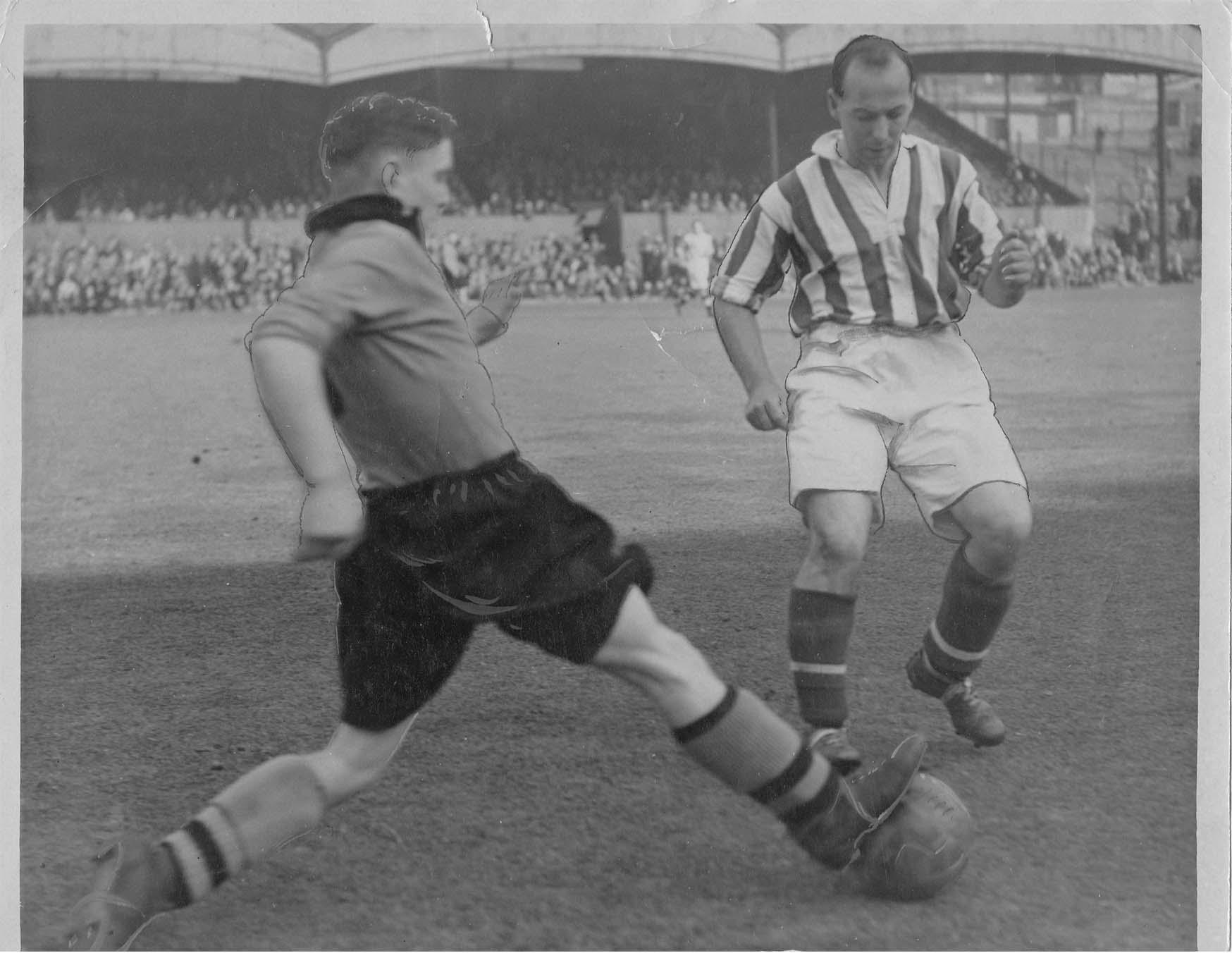
During this season, on 26th September 1942, Wolves fielded what is believed to be the youngest player ever to appear for the club's first team when Scot Cameron Campbell Buchanan made his debut against West Bromwich Albion at the remarkable age of 14 years, one month and 26 days.
Because wartime matches are not included in the official records, Buchanan's achievement is not recognised as the club's official youngest debut. The official record instead belongs to Jimmy Mullen, who made his senior debut in February 1939 at the age of 16 years, one month and nine days.
Although Buchanan's appearance came under the unique circumstances of wartime football, it remains an extraordinary milestone in Wolves' history and a testament to the opportunities the war years afforded young players.
1943/44
The 1943/44 season also brought concern for one Wolves player. Alan Steen, who had made his Wolves debut before the war at the age of 16, was reported missing following a bomber raid over Germany on 2nd October 1943.
He spent the remainder of the war as a prisoner of war in Stalag IV-B, a camp located near Mühlberg in Germany. Fortunately, he survived his ordeal and returned home after the conflict ended.
One very interesting name who featured for Wolves this season was that of Emilio Aldecoa. Aldecoa was a Spanish Civil War refugee who had come to the UK in 1937, joining Wolves in 1943 from Staffordshire Electrical Works Team.
Aldecoa made his debut for Wolves on Saturday 28th August 1943 against Crewe Alexandra at Molineux, also scoring in Wolves’ 4-2 defeat. He was Wolves’ top scorer during the 1943/44 season with 11 goals in 30 appearances.
However, he was never to play for Wolves competitively, leaving the club for Coventry City in August 1945, before playing for Athletic Bilbao, Real Valladolid, Barcelona, and Sporting de Gijon, as well as winning one cap for Spain.
Major Frank Buckley’s legacy
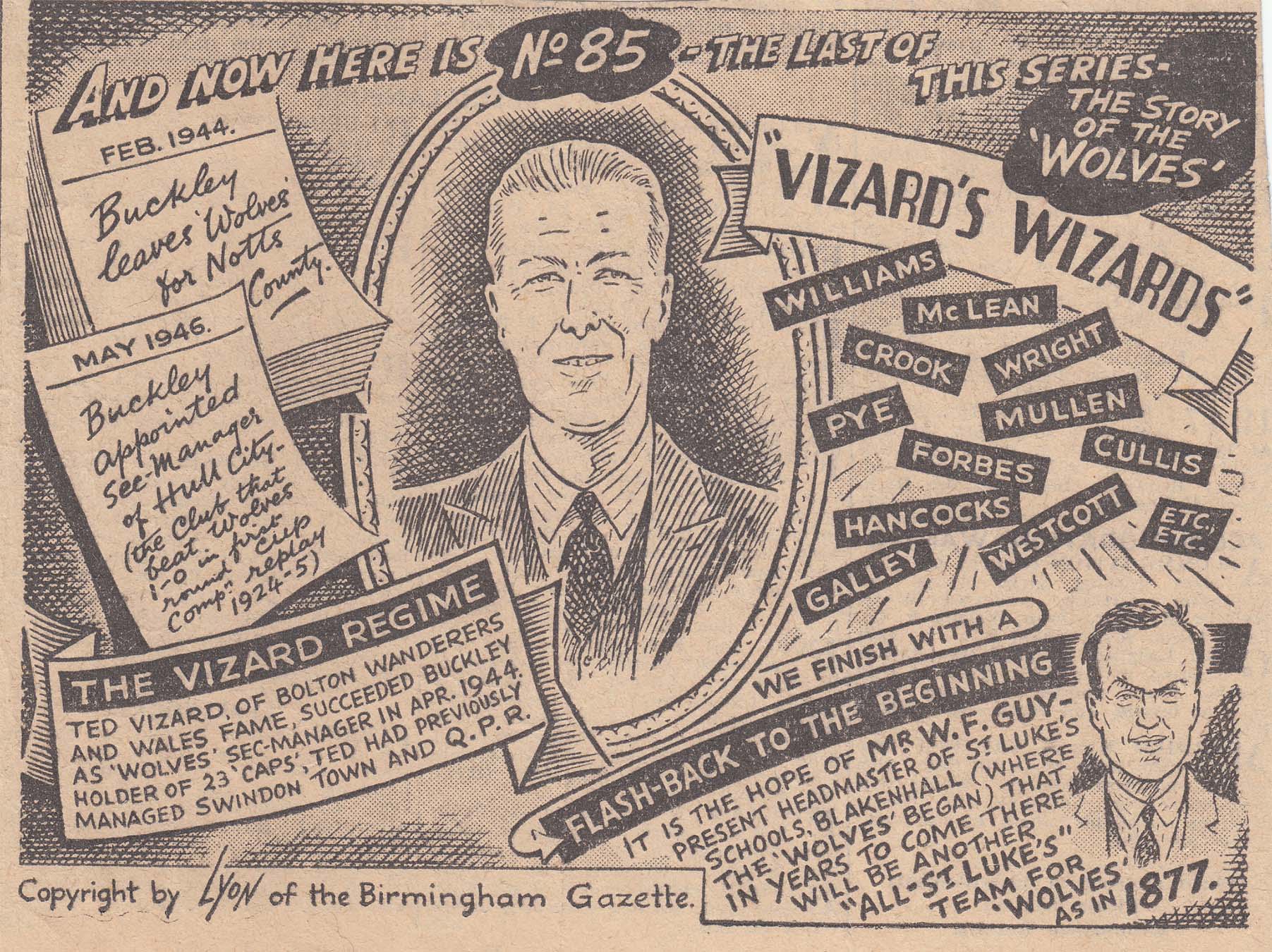
Major Frank Buckley resigned as Wolves manager in February 1944, despite still having four years remaining on his contract. In fact, Buckley had signed a new ten-year agreement in 1938 and, only a month before his departure, had described it as a “contract for life”.
His resignation was officially attributed to personal reasons, although speculation suggested it may also have been linked to the retirement of his long-time ally, chairman Ben Matthews. Wolves moved quickly to appoint a successor, with Ted Vizard taking over as manager on 6th April 1944.
Although he didn’t win much at Molineux – with the exception of the Second Division in 1932, the Midland War League in 1940 and the War Time Cup in 1942 – Buckley left a huge legacy at Wolves, leaving the club in much better shape than he found it.
Buckley’s Babes, as the team became known, finished as runners-up in 1937/38 and 1938/39 and narrowly missed out on the cup before the Second World War interrupted Buckley’s managerial career, just as the First World War had halted his playing career.
Major Buckley’s Wolves looked like they were primed for some success, and maybe if war hadn’t broken out it would have been Buckley who delivered Wolves their first ever First Division title.
An innovator and a man ahead of his time, Buckley started Wolves’ youth system, scouting networks, nutritional diets for the players and training regimes, and like any top manager left no stone unturned. He even experimented with the famous Monkey Glands.
He also signed Stan Cullis in 1934, making it clear to Cullis early on in his Wolves career that if he did what Buckley told him he would become Wolves captain, and Cullis did just that, becoming our most successful manager and the man who took on the Buckley legacy and turned Wolves into a force.
After Wolves, Buckley went onto manage Notts County between 1944 and 1946. Just before he left Nottingham, he also did Wolves a favour by selling Jesse Pye who was an excellent player for the club in the early 1950s.
Buckley’s final club was Walsall between 1953 and 1955, and he resided in the town until he passed away in December 1964 at the age of 82.
Franklin Charles Buckley, we salute you for what you did for our club and the contribution you made.
1944/45
The final season of the wartime hostilities again featured three regional leagues. Wolves were in the Northern League.
One particularly interesting name to appear for Wolves that season was Jack Harris, who made six appearances. This was indeed the same Jack Harris who remained a lifelong Wolves supporter and would become one of the key figures involved in saving Wolves during the financial crisis of the summer of 1986.
Following Dick Homden’s departure in 1988, he became chairman and held the position until 1992, when he was succeeded by Jonathan Hayward. Even then, Harris remained on the Wolves board until 2003.
In recognition of his service, Sir Jack Hayward named the rebuilt South Bank after him when it reopened in 1993. Harris also played a crucial role in many of Wolves' transfer dealings during the early Gallagher Estates era, often acting as guarantor alongside Homden. The family connection continued through his son, John Harris, who served as a Wolves director from 1986 until 2004.
Wolves also enjoyed a respectable run in the Northern Section of the 1944 Wartime Cup, reaching the quarter-finals. The first leg against Bolton Wanderers at Molineux ended in a 2-2 draw in front of 29,149 spectators. In the return match at Burnden Park, watched by 29,683 fans, Bolton won 2-1 to progress 4-3 on aggregate.
Bolton went on to reach the Northern Final, beating Manchester United 1-0 in the first leg at Burnden Park before a crowd of 40,000. The second leg ended 2-2 at Maine Road in front of 4,000 spectators. Manchester United were using Maine Road during this period after Old Trafford had been damaged by bombing during the war.
Alex McIntosh
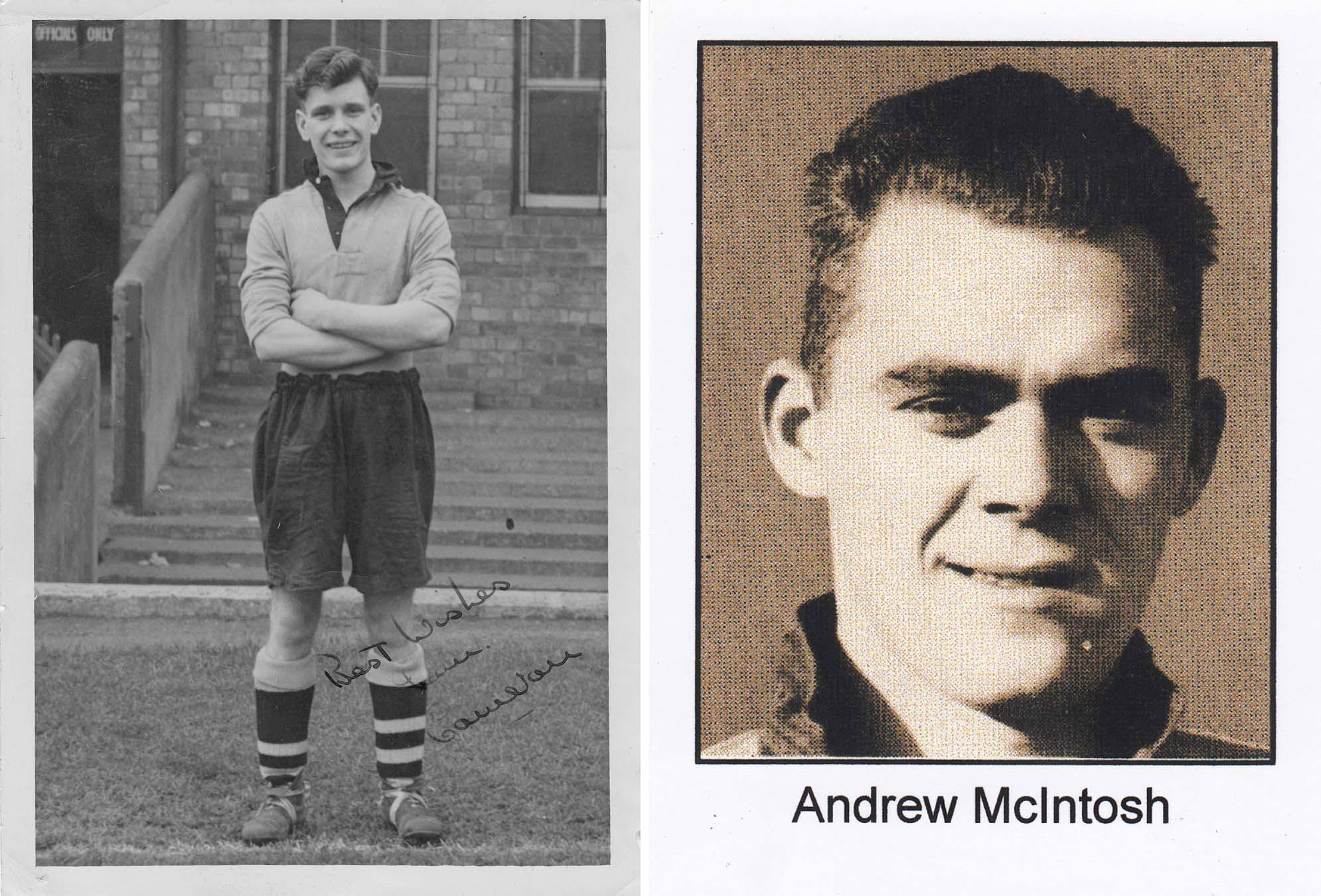
During the season, it was also reported that Alex McIntosh was missing on 23rd April 1945. McIntosh (pictured below right, with Cameron Buchanan) had been taken prisoner of war while serving in France, leading to concerns for his safety. Thankfully, he survived the conflict and returned home.
McIntosh's Wolves career spanned a decade between 1937 and 1947, during which he made 50 appearances and scored nine goals.
1945/46
Although the war was nearing the end, football did not return to normality straight away. The season saw the Football League North and South, but also the return of the FA Cup. Wolves were in the Southern League and finished sixth.
The FA Cup saw two-legged games. Wolves beat Lovells Athletic from Newport, South Wales in the third round, a tie which saw Billy Wright make his full debut. However, Wolves were knocked out in the next round against Charlton Athletic.
Wolves players guesting
As we have seen, Wolves had players who guested for them during the war, such as the Rowley Brothers, but some Wolves players also guested for other clubs during the 1940/41 season.
Wolves guests included Stan Cullis with Aldershot, Ted Elliot with Glentoran, Ray Goddard with Cardiff City, Jimmy Hooks with Newry Town, Teddy Maguire with Crook Town, Alex McIntosh with Ashington & Newcastle United and Joseph Rooney with Portadown
Jimmy Mullen, Arthur Smith, Cyrill Sidlow, Dennis Thornhill and Billy Wright all featured for Leicester City, while Sidlow, Thornhill and Dennis Westcott (who played for Watford during 1941/42) also turned out for Notts County.
Wolves’ Second World War heroes
Everyone who served during the war were heroes. Players, officials and supporters alike put their football careers and everyday lives on hold to answer their country's call.
The following Wolves players all served during the Second World War: Jack Acquroff, Jimmy Alderton, Albert Brown, Cameron Buchanan, Peter Broadbent, Gordon Brown, Robert Brown, Stan Cullis, Norman Deeley, Dickie Dorsett, Jimmy Dunn, Ron Flowers Tom Galley, Len Gibbons, Johnny Hancocks, James Hewett, Jack Kirkham, Trevor Long, Alex McIntosh, Angus McLean, Jimmy Mullen, Benjamin Pritchard, Jesse Pye, Paddy Radcliffe, Eric Robinson, John Rooney, Alex Scott, Alfred Somerford, Bill Shorthouse, Cyril Sidlow, Nigel Sims, Alan Steen, Dennis Westcott, Billy Wright and Bert Williams, as well as Sir Jack Hayward and many more.
McIntosh, Radcliffe and Steen all spent time as prisoners of war, while Shorthouse was wounded in the D-Day landings.
While many returned home, sadly not all were so fortunate.
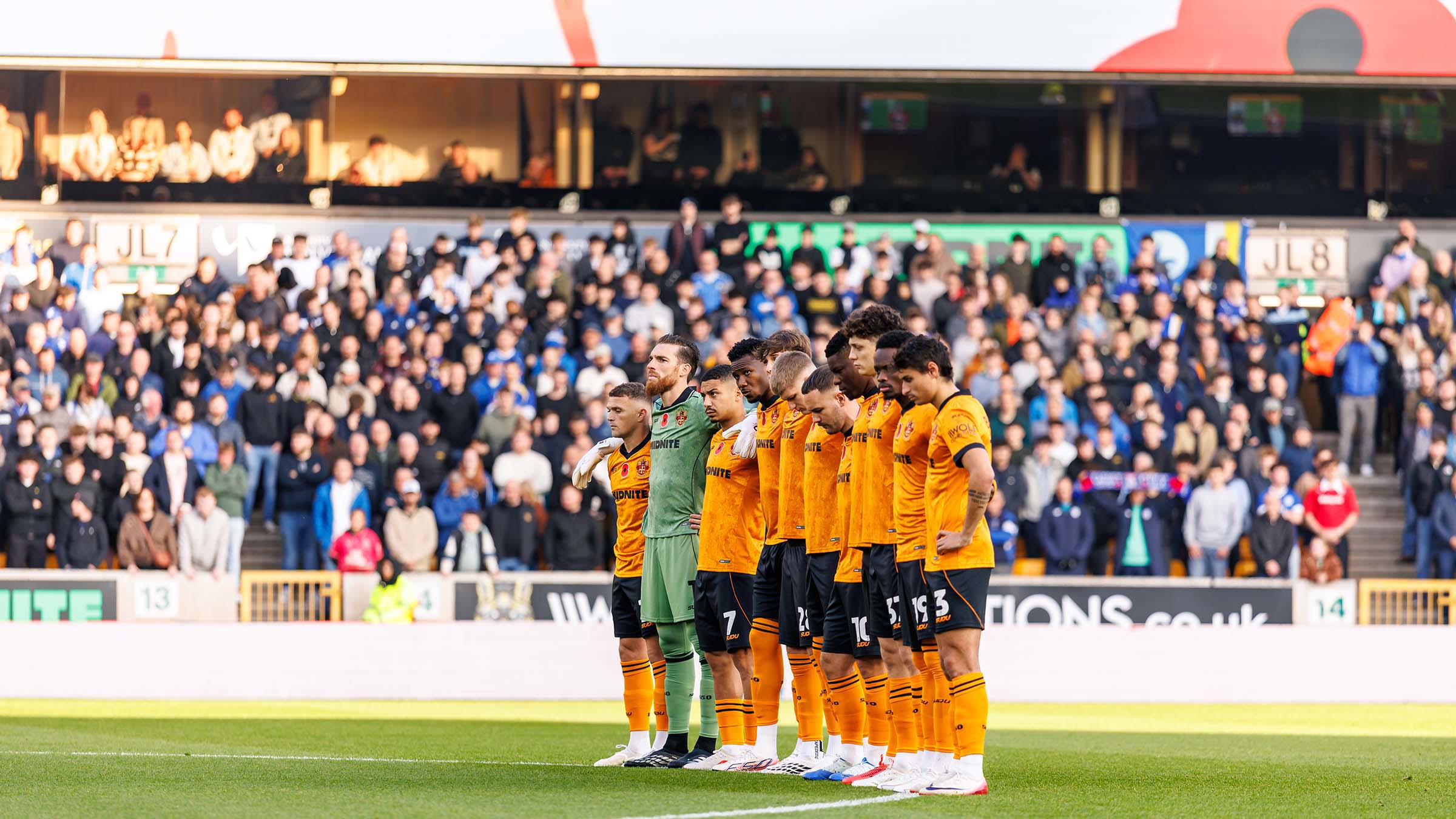
The club lost several former and current players during the conflict, men who made the ultimate sacrifice while serving their country.
John Rooney
Rooney was born in Walker, a suburb of Newcastle Upton Tyne. Rooney signed for Wolves in 1938, and he played two official games during the 1938/39 season. Rooney played on 11th April 1939 versus Aston Villa away and on 15th April 1939 against Charlton Athletic at home. Rooney was stationed in Northern Ireland and was sadly killed in an air raid in Belfast on 5th May 1941.
Eric Robinson
Robinson was born in Burnley in 1919 and joined Wolves from Fleetwood late in the 1937/38 season, but when the war broke out in 1939, he joined the 1st Battalion of East Lancashire Regiment. Robinson was a big part of the 1942 War Time Cup win, scoring two goals in the semi-final first leg against West Bromwich Albion.
Robinson played his final game for Wolves on Saturday 6th June 1942 at Stamford Bridge as Wolves played Brentford to raise money for King George’s Sailor Fund, being taken off during the game due to sun stroke.
On 20th August 1942, Robinsons battalion went on exercise to the banks of the River Derwent near Malton in Yorkshire. Though many of the battalion could not swim, they were ordered to cross the river in full battle gear. Tragically five of the regiment were killed, one of the men was Eric Robinson who died at 23 years of age, making valiant attempts to save others. Robinson’s grave is at St Paul’s Church in Matron near Blackpool, where his parents lived.
Jack Kearns
Jack Kearns was at Wolves for the 1937/38 season and though he didn’t play a first team or Central League game, he featured for the ‘Wolves A’ side which was the club’s third team or senior youth team. Kearns also played for Millwall and, just before the war broke out, Tranmere Rovers, before he died in active service on 14th February 1945 serving as a bombardier in Royal Artillery.
Sidney Broome
It is believed that Sidney Broome had an attachment to Wolves in 1937 but was killed on 10th November 1942 as a member of Bomber Command. Broome was in a Halifax when he was killed in a raid over Germany. His plane came down over the Dutch coast.
All these names remain an important part of Wolves' history, serving as a reminder that behind the statistics, matches and trophies were individuals whose lives were forever shaped by war.
Wolves historian Pete Crump’s weekly articles reflecting on a range of topics from the club’s proud past will be available throughout the 150th anniversary season on wolves.co.uk.


